








E0 Certified Laminate Flooring Meets Global Environmental Standards
 Oct 14, 2026|
 View:11
Yes, e0 certified laminate flooring meets strict global environmental standards for formaldehyde emissions. The e0 label marks a low-emission standard. It usually means a formaldehyde limit of 0.5 mg/L or less under test methods like EN 120. Chamber methods such as EN 717-1 and GB/T 39600-2021 set the same e0 level at 0.05 mg/m³ or less. These limits show how certified laminate flooring controls emissions at the source.
Verified e0 products support safer indoor air. They also meet international rules, including the upcoming EU e05 standard in 2026. That e05 rule sets stricter formaldehyde limits for wood-based products across European environmental standards. Buyers who choose e0 flooring today get a measurable health benefit and an early start on tomorrow's stricter rules.
Key Takeaways
E0 certified laminate flooring gives off very little formaldehyde, meeting tough global standards.
E0 products already meet the new EU E05 rule, which begins in 2026.
Outside groups like FloorScore and GREENGUARD Gold check that emissions are low.
Choosing E0 flooring helps make indoor air cleaner and supports green building credits.
Always ask for test reports to check a product's formaldehyde emissions.
E0 Certified: What the Label Means
The e0 rating means a product gives off very little formaldehyde gas into the air. Formaldehyde is a common chemical found in many building materials. It can bother your eyes, nose, and throat. Companies use glues with formaldehyde to hold wood fibers together in laminate flooring. The e0 class sets a strict cap on how much of this gas can leave the finished product.
Formaldehyde Limits and Test Methods
Scientists measure formaldehyde emissions using several standard lab methods. Each method gathers air samples in a different way. The results show up in different units. A perforator extraction test, called EN 120, reports results in milligrams per 100 grams of material. Desiccator methods like ASTM D 5582 and JIS A 1460 report results in milligrams per liter. Chamber methods such as EN 717-1 and ISO/FDIS 12460-1 report results in milligrams per cubic meter.
Method Category | Standard Code | Measurement Unit |
|---|---|---|
Perforator extraction | EN 120 | mg/100g |
Desiccator | ASTM D 5582 | mg/L |
Desiccator | JIS A 1460 | mg/L |
Chamber | EN 717-1 | mg/m³ / ppm |
Chamber | ISO/FDIS 12460-1 | mg/m³ |
Chamber | ASTM E 1333 | mg/m³ / ppm |
The e0 formaldehyde emission limit sits at or below 0.5 mg/L under desiccator testing. Chamber methods set the same e0 level at 0.05 mg/m³ or less. These numbers apply to low-emission laminate flooring sold around the world.
E0 vs. E1 and Other Low-Emission Grades
The e1 and e0 classes differ in how much formaldehyde they allow. Under desiccator testing, e1 permits up to 1.5 mg/L. The e0 class cuts that figure to 0.5 mg/L or less. A third grade, e2, allows up to 5.0 mg/L. These three grades form a clear ladder of emission control.
Grade | Formaldehyde emission limit (desiccator test value) |
|---|---|
E0 | ≤ 0.5 mg/L |
E1 | ≤ 1.5 mg/L |
E2 | ≤ 5.0 mg/L |
Regional standards add their own numbers. Europe's EN 13986+A1-2015 sets e1 at 0.124 mg/m³ using the EN 717-1 chamber test. China's GB/T 39600-2021 sets e1 at 0.124 mg/m³, e0 at 0.050 mg/m³, and a stricter ENF grade at 0.025 mg/m³. The e1 vs e05 comparison matters for buyers watching the upcoming e05 rule. That European standard will tighten limits further in 2026.
The e1/e0 standards give buyers a simple way to compare products. A lower number means less formaldehyde emissions. The e0 classification represents one of the tightest grades available today for laminate flooring. Always check which test method produced the number on a label. A result from one method does not equal a result from another.
Global Formaldehyde Regulation and the EU E05 Standard 2026
CARB Phase 2, TSCA Title VI, and CE/EN Requirements
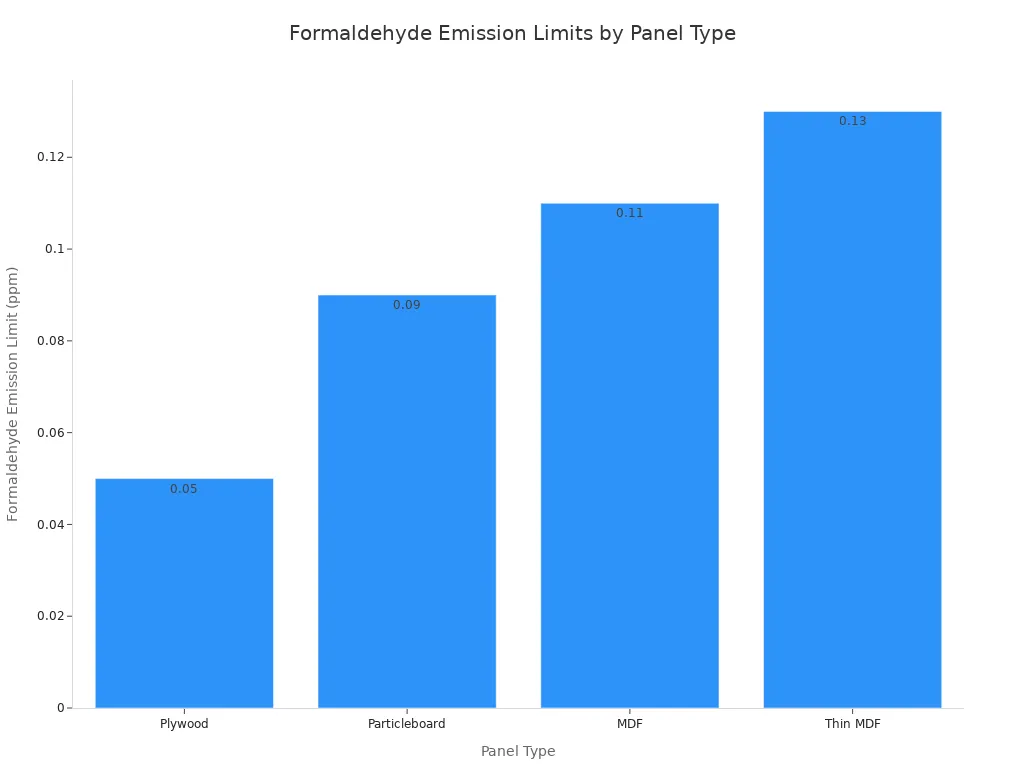
California put the first strict limits on composite wood panels. CARB Phase 2 sets the formaldehyde limit for hardwood plywood at 0.05 ppm. Particleboard cannot go above 0.09 ppm. MDF has a limit of 0.11 ppm. Thin MDF, 8 mm or less, allows 0.13 ppm. The United States uses these same values under TSCA Title VI. Laminate flooring in North America uses cores that meet these rules.
Europe does things differently. The CE marking system under Regulation (EU) No 305/2011 requires emission tests for flooring. EN 14041 lists the rules. EN 717-1 uses a climate chamber for 28 days. EN 16516 gives another option but shows 20 to 30 percent higher for the same panel. A product may pass the old E1 limit under one method and fail under another. The pass/fail result depends on the chosen method. Buyers should name the exact standard number, not just the class letter.
EU E05 Formaldehyde Regulation 2026
The European Union passed Regulation (EU) 2023/1464. The EU e05 formaldehyde regulation 2026 updates REACH Annex XVII. It introduces the EU e05 standard for wood-based products. The new rule starts on August 6, 2026. The new formaldehyde limit is 0.062 mg/m³. That amount is half the old E1 value of 0.124 mg/m³.
The new rule is for Northern Ireland, not Great Britain. Companies shipping across Europe must watch these new EU e05 rules closely. The limit covers gases from wood-based articles and furniture. This change finishes a steady effort to make indoor air cleaner.
E0 rated laminate flooring already falls below the E05 limit. This grade allows 0.05 mg/m³ in chamber tests. The EU limit of 0.062 mg/m³ leaves extra room. The small gap gives certified products a head start in the stricter era. Buyers can trust that these EU formaldehyde limits will not cause hidden changes. Healthier indoor air becomes the standard across the continent.
How E0 Certified Laminate Meets Global Environmental Standards
E0 vs. CARB, CE, GB, and JIS Limits
An e0 certified laminate floor measures 0.050 mg/m³ in chamber testing. That number comes from China GB/T 39600-2021. The same standard sets a stricter ENF tier at 0.025 mg/m³. Outside China, e0 works as a market convention. It is not a harmonized EU or CE grade. The EU EN 13986 E1 panel limit is 0.124 mg/m³ by EN 717-1. Germany enforces a 0.1 ppm ceiling under EN 16516. That method doubles EN 717-1 results before comparison. The effective old-method ceiling is 0.05 ppm. An e0 product near 0.04 ppm would pass. EU REACH Annex XVII will apply 0.062 mg/m³ to furniture and wood-based articles from August 2026. That e05 rule is looser than e0 by about 1.24 times.
Scheme | Limit | Test Basis | Position vs E0 (0.050 mg/m³) |
|---|---|---|---|
China GB/T 39600-2021 E0 | 0.050 mg/m³ | Chamber | Reference level |
China GB/T 39600-2021 ENF | 0.025 mg/m³ | Chamber | Stricter (2×) |
EU EN 13986 E1 | 0.124 mg/m³ | EN 717-1 | Looser (about 2.5×) |
EU REACH (2026) | 0.062 mg/m³ | Chamber | Looser (about 1.24×) |
CARB Phase 2 plywood | 0.05 ppm | Large chamber | Looser |
CARB Phase 2 particleboard | 0.09 ppm | Large chamber | Looser |
CARB Phase 2 MDF | 0.11 ppm | Large chamber | Looser |
Japan F | 0.3 mg/L | Desiccator | Different unit; ~0.035 ppm |
CARB Phase 2 limits are product-specific and expressed in ppm. Hardwood plywood allows 0.05 ppm. Particleboard allows 0.09 ppm. MDF allows 0.11 ppm. Thin MDF allows 0.13 ppm. Japan F uses a desiccator limit of 0.3 mg/L. Published correlations place it near 0.035 ppm on the American large-chamber method. That value is broadly similar to, and slightly stricter than, e0's roughly 0.04 ppm. The e0 classification is stricter than EU E1, EN 16516, 2026 REACH, and all CARB Phase 2 limits. China's ENF tier is stricter still.
Third-Party Testing and Certification Marks
Real e0-grade environmental performance depends on independent third-party formaldehyde testing. A label alone proves nothing. Recognized certifications include FloorScore, GREENGUARD Gold, and Blue Angel. These programs verify low-emission laminate flooring through chamber testing. Chamber testing measures formaldehyde plus other volatile organic compounds. That broader scope matters for indoor air quality.
Manufacturer | Certifications | Verified Emission Level |
|---|---|---|
Mannington | FloorScore | Low-VOC verified |
Baier Flooring | EPA TSCA VI, GREENGUARD, FloorScore | <9 ng/m³ VOC; NAF core |
NexxaCore | FloorScore, ASSURE | Non-detectable formaldehyde |
Tarkett | Eurofins Gold/Platinum, Blue Angel | TVOC <100 µg/m³ after 28 days |
Evoke Flooring | GREENGUARD Gold, CANFER | Formaldehyde <0.0073 ppm |
Inhaus Surfaces | CARB2, TSCA VI, GREENGUARD Gold | PVC-free, low-emission verified |
Safe formaldehyde levels of ≤0.0073 ppm meet or exceed e0 requirements. These third-party emission testing programs rely on the CDPH 01350 Standard. Green building rating systems like LEED and WELL accept that standard. Environmental compliance therefore rests on documented test results, not marketing claims. Buyers should request lab reports that name the exact test method and the measured formaldehyde emission limit.
Why Low-Formaldehyde Floors Are Healthier and Greener
Indoor Air Quality and Respiratory Benefits
Formaldehyde causes serious health problems when levels inside buildings get too high. The International Agency for Research on Cancer puts this chemical in Group 1, which means it can cause cancer. The EPA toxicological review found that breathing it in can cause nasopharyngeal cancer, sinonasal cancer, and myeloid leukemia. Being around it for a long time is tied to chronic breathing problems like asthma and bronchitis. Research also shows it can harm reproductive and developmental health.
Health Effect Category | Documented Outcome |
|---|---|
Respiratory conditions | Long-term exposure linked to chronic respiratory conditions such as asthma and bronchitis |
Cancer classification | Classified as a Group 1 carcinogen by the International Agency for Research on Cancer (IARC) |
Inhaled carcinogenicity | EPA toxicological review concluded inhalation can cause nasopharyngeal cancer, sinonasal cancer, and myeloid leukemia |
Reproductive and developmental health | Serious effects on reproductive health and development; reproductive toxicity in men and women; developmental toxicity in females |
Vulnerable populations | People with asthma and COPD may experience worsened conditions; pregnant women, children, and the elderly may be more sensitive |
EPA-defined outcomes | Increased sensory irritation, respiratory tract pathology, decreased pulmonary function, increased asthma symptoms, and increased allergic responses |
Formalin is used as a bonding agent and coating in the manufacture of common construction materials such as plywood, particle board, and laminate flooring. Indoors, where concentrations can rise to 10 ppm or even 20 ppm or higher in buildings that have recently been built or restored, formaldehyde exposure has become a serious health risk - particularly for children, the elderly, and people with asthma or other breathing problems.
Laminate flooring that gives off less gas helps lower these risks. GREENGUARD Gold certified products cut down formaldehyde emissions that would otherwise harm indoor air quality. Children, the elderly, and people sensitive to chemicals are more at risk from VOC-related health problems. People with asthma and breathing diseases like Chronic Obstructive Pulmonary Disease face even more danger from formaldehyde exposure. Picking ultra-low emission laminate flooring helps you avoid this big source of toxic compounds.
Supporting Green Building and Sustainable Material Sourcing
Green building certification systems give credit to projects that use materials with low emissions. FloorScore is accepted by LEED, WELL, CHPS, and BREEAM. GREENGUARD is accepted by LEED and WELL, but not by CHPS or BREEAM. CRI Green Label Plus is accepted by LEED, WELL, and CHPS, but not by BREEAM.
Certification | LEED | WELL | CHPS | BREEAM |
|---|---|---|---|---|
FloorScore® | ||||
GREENGUARD | ||||
CRI Green Label Plus |
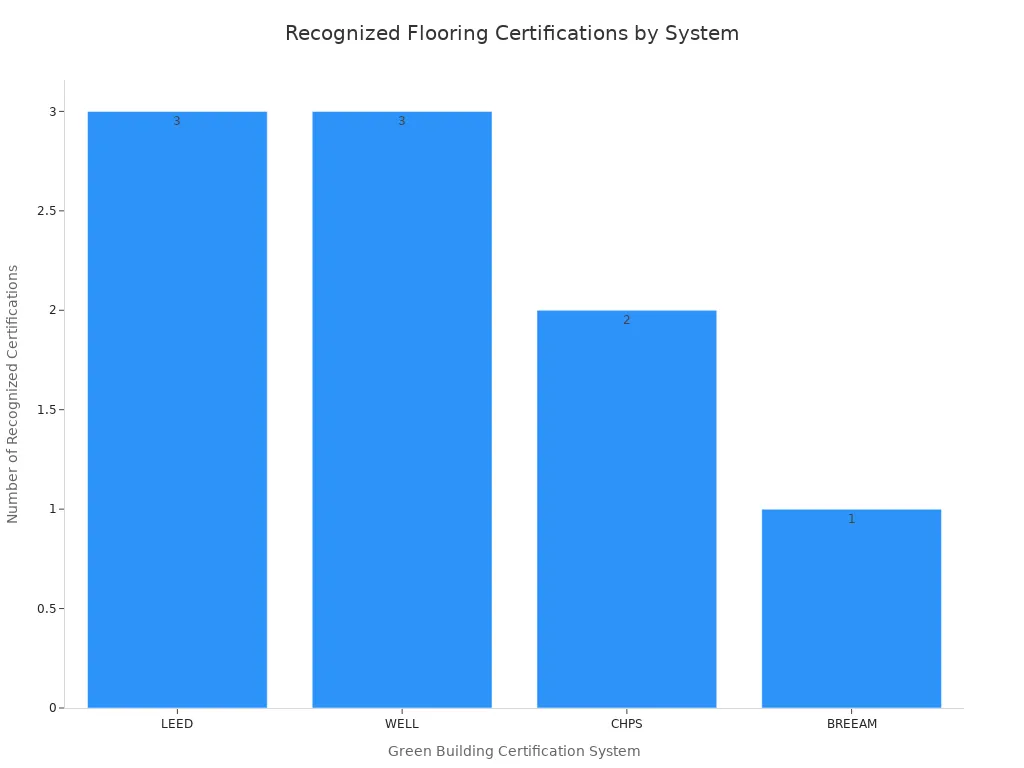
FloorScore tests finished flooring for VOC emissions, including laminate, and major green building programs such as LEED and WELL accept FloorScore for low-emitting flooring credits. For composite wood and laminate flooring, CARB II and TSCA Title VI compliance documents may also be required because LEED credits and some state projects require proof of CA Section 01350 or similar VOC tests. Choosing e0 or e05 ready products supports environmental compliance and healthier indoor spaces.
How to Verify E0 and E05-Ready Laminate Flooring
Check Labels, Test Reports, and Compliance Marks
Buyers should look at the product label first. A real e0 certified product has a clear compliance mark. Two marks are most important for checking formaldehyde.
Mark | Meaning | Relevance to Formaldehyde Compliance |
|---|---|---|
CARB 2 | California Air Resources Board compliance | Shows low formaldehyde emissions directly |
CE | Conformité Européenne declaration | Confirms EU limits for formaldehyde and VOC emissions |
A label by itself proves nothing. Buyers must ask for the full test report from an independent lab. The report should name the exact test method and the measured emission value. Vague claims like "eco-friendly" or "green flooring" have no legal weight. Only documented test results confirm environmental compliance.
Richwood sends test reports, installation guides, and warranty information with every order. The company has ISO9001, ISO14001, CE, CARB, and SGS certifications. Its laminate flooring meets E0/E1 formaldehyde standards and AC3-AC5 wear ratings. Buyers can ask for free samples delivered within 7 days to check build and finish before buying.
Questions to Ask Before You Buy
Smart buyers ask direct questions before they place an order. These questions separate real low-emission laminate flooring from marketing claims.
Can you give me current third-party test reports for this product?
Which exact standard does the e0 or e05 claim refer to?
Does the warranty cover product and manufacturing defects?
What are the common warranty exclusions, especially for water damage?
Can I check certifications on my own through the issuing body?
Warranty coverage needs special attention. Buyers should ask if standing water, subfloor moisture, or installation mistakes can void coverage. A clear manufacturer warranty protects the purchase. Richwood offers a fast claims process that fixes issues within five days.
The eu e05 standard starts in 2026. Buyers who want e05-ready laminate flooring should make sure the supplier can give updated test documents. Richwood does strict in-line inspections and third-party lab tests on every batch. This practice keeps emissions performance the same across orders. Asking for proof before purchase is still the best way to confirm e05-ready flooring meets real environmental standards.
E0 certified laminate flooring meets or exceeds major global environmental standards for formaldehyde emissions when reliable third-party verification backs the claim. The e0 label is not just a marketing term. It stands for measurable limits that support healthier homes and a cleaner environment. Buyers should ask for proof, verify the certification, and choose e0 or e05-ready laminate flooring from a supplier that provides test reports. The e05 rule arrives in 2026. A floor with documented formaldehyde and emissions results protects your family today and keeps you ready for tomorrow.
FAQ
What does E0 certification mean for laminate flooring?
E0 certification means the product gives off very little formaldehyde gas. The limit is 0.5 mg/L or less under desiccator testing. Chamber methods set the same level at 0.05 mg/m³ or less. This grade is one of the tightest emission classes for laminate flooring today.
How does E0 compare to the upcoming E05 standard?
The e05 rule starts on August 6, 2026. It sets a formaldehyde limit of 0.062 mg/m³ for wood-based products. An e0 product already meets this stricter limit. The e0 level of 0.05 mg/m³ falls below the e05 threshold. Buyers who pick e0 laminate flooring get a head start on future rules.
Which global standards does E0 certified laminate flooring meet?
E0 products meet or beat several major standards. These include China GB/T 39600-2021, EU EN 13986 E1, CARB Phase 2, and Japan F. The e0 classification is stricter than EU E1 and all CARB Phase 2 limits. Only China's ENF tier is stricter. Third-party testing confirms these formaldehyde emissions.
What certifications should I look for when buying?
Look for FloorScore, GREENGUARD Gold, or Blue Angel marks. These programs verify low emissions through independent chamber testing. A CARB 2 or CE mark also shows compliance. Always ask for the full test report. The report should name the exact test method and measured formaldehyde value.
Can I trust vague green claims on flooring labels?
No. Terms like "eco-friendly" or "green flooring" have no legal weight. Only documented test results from independent labs confirm environmental compliance. Ask for current third-party reports. Check which exact standard the e0 or e05 claim refers to. Real certification depends on measurable formaldehyde limits, not marketing words.